
For Publishers
75+ years of trusted dental knowledge, now an AI-native product.
Quintessence Publishing partnered with Uthereal to transform decades of expert content into Quintessence AI: an evidence-based, citation-grounded assistant that helps dental professionals get faster, safer answers at the chairside.
75+
Years of IP activated
AI-native
New product line
100%
IP retained

How Uthereal helps publishers
Uthereal helps publishers build knowledge agents on top of their own content and collections. That can mean helping a reader find the right answer faster, helping a student understand a topic, or helping a professional navigate a specific question with grounded, traceable output.
This is not about putting a chatbot on top of a website. It is about turning trusted knowledge into a usable product layer, while keeping control over access, brand, and rights.
Use cases
- Reader assistants for books, journals, and digital libraries
- Study companions for courses, institutions, and exam prep
- Reference tools for professionals working from specialist content
- Internal editorial and research assistants
- Knowledge agents built around specific collections, specialties, or content verticals
Your Challenge / Problem
AI is answering your readers' questions with your content, without your name.
Your readers now ask AI first. The answer is built from your expertise — but without your brand, citation, or revenue.
The question is settled
AI already sits between your content and your audience.
The value is leaking
Answers are delivered without your brand, your citation or your margin.
The choice that remains
Whether that AI is someone else's, or yours.
The choice in front of every publisher is not whether AI sits between your content and your audience. It already does. Uthereal exists to make the answer yes, through a defined, repeatable process that takes a publisher from catalog to launched AI product line.
From publishing content to AI product line, in five stages
Each stage produces a concrete asset. By the end, you don't have an "AI strategy", you have products in market and a new layer of IP on your balance sheet.
Identify your Content Assets
Every catalog contains three kinds of value. Most publishers only monetize one.
The process begins with a structured audit of your catalog, not by format or imprint, but by answer-value: which content resolves the questions your audience actually asks?
- Answer assets: reference works, clinical guidance, standards, procedures, review articles. Content people consult to decide and act.
- Evidence assets: primary research, data, trials, proceedings. Content that backs up answers with citations and provenance.
- Context assets: textbooks, monographs, historical archive. Content that gives answers depth, nuance and teaching value.
Output: Content Asset Map: a ranked inventory of what you own, which audience segments it can serve, and which AI products it can power.
Design your Knowledge Objects
This is where content becomes a new class of intellectual property.
Documents are how humans read. They are not how AI reasons. Uthereal decomposes your content into Knowledge Objects: structured, source-linked units of meaning extracted from your corpus.
- A clinical procedure with its indications, contraindications and evidence trail
- A defined concept and its relationships to every other concept in your field
- An evidence claim linked to the studies that support or dispute it
- A standard or threshold with its jurisdiction, version and effective date
Output: Knowledge Object Library: the asset every subsequent product is built from.
Design the product line
Products become a packaging exercise, not an engineering project.
One corpus typically supports several products: a chairside clinical assistant for practitioners, a literature companion for researchers, a training tool for students, a compliance reference for institutions. Each is scoped, branded and priced independently. Same library underneath.
Output: Product Line Blueprint: pricing, packaging and launch sequence.
Deploy, white-labeled and sovereign
Your users see your name on every answer. They never see ours.
Uthereal deploys each product on your domain, in your brand, on Sovereign infrastructure with zero data retention. Your corpus never trains a foundation model; your users' questions are never retained or resold. Subscriptions, institutional seats and usage analytics are built in from day one.
Output: A live, branded AI product on your own domain.
Launch, learn, extend
Old publishing shipped editions. New publishing runs a loop.
You launch to the audience you already have: subscribers, members, institutional customers. Usage data shows what your market is really asking, which feeds editorial and acquisition strategy, which enriches the Knowledge Object Library, which improves the products.
Output: A compounding product and intelligence loop you own.
Why turning your content to AI Products or Knowledge Objects matter commercially?
Precision & defensibility
Knowledge Objects give answers the disciplinary specificity your readers expect, with built-in citations and provenance. Your corpus, editorial standards and rights make the product credible and defensible.
Monetisation power
Documents sell once. Knowledge Objects sell continuously. One corpus creates multiple revenue lines through subscriptions, seats, APIs and usage tiers. You gain value-based pricing, full margins and recurring relationships.
A second layer of IP
Copyright protects your documents. Knowledge Objects become a new, separately ownable asset and a defensible knowledge layer competitors cannot reproduce.
Reusability
The same Knowledge Objects can power a practitioner assistant, student tutor or institutional research tool. Build the layer once, then launch repeatedly.
The solution
Dental professionals rely on high-quality, evidence-based information, but the best answers are scattered across books, journals, articles, and specialist resources. Uthereal worked with Quintessence to build an AI assistant tailored specifically to dentistry, preserving editorial authority and protecting IP while making content immediately useful in daily practice.
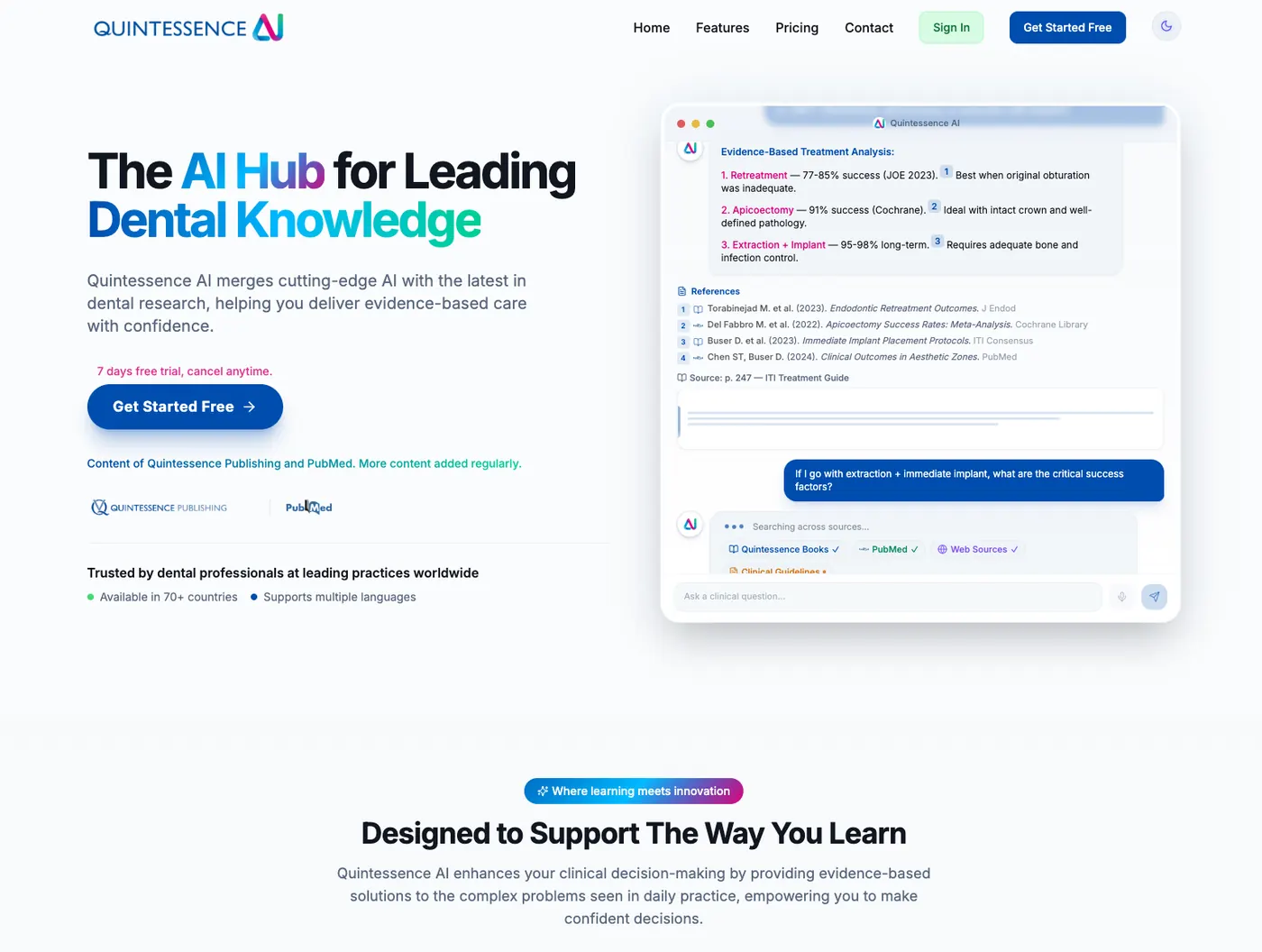
Step 1
A conversational chairside assistant
Quintessence AI gives practitioners a modern, conversational interface over the publisher's trusted content: clinical guidelines, evidence-based references, and expert recommendations, all on-demand.
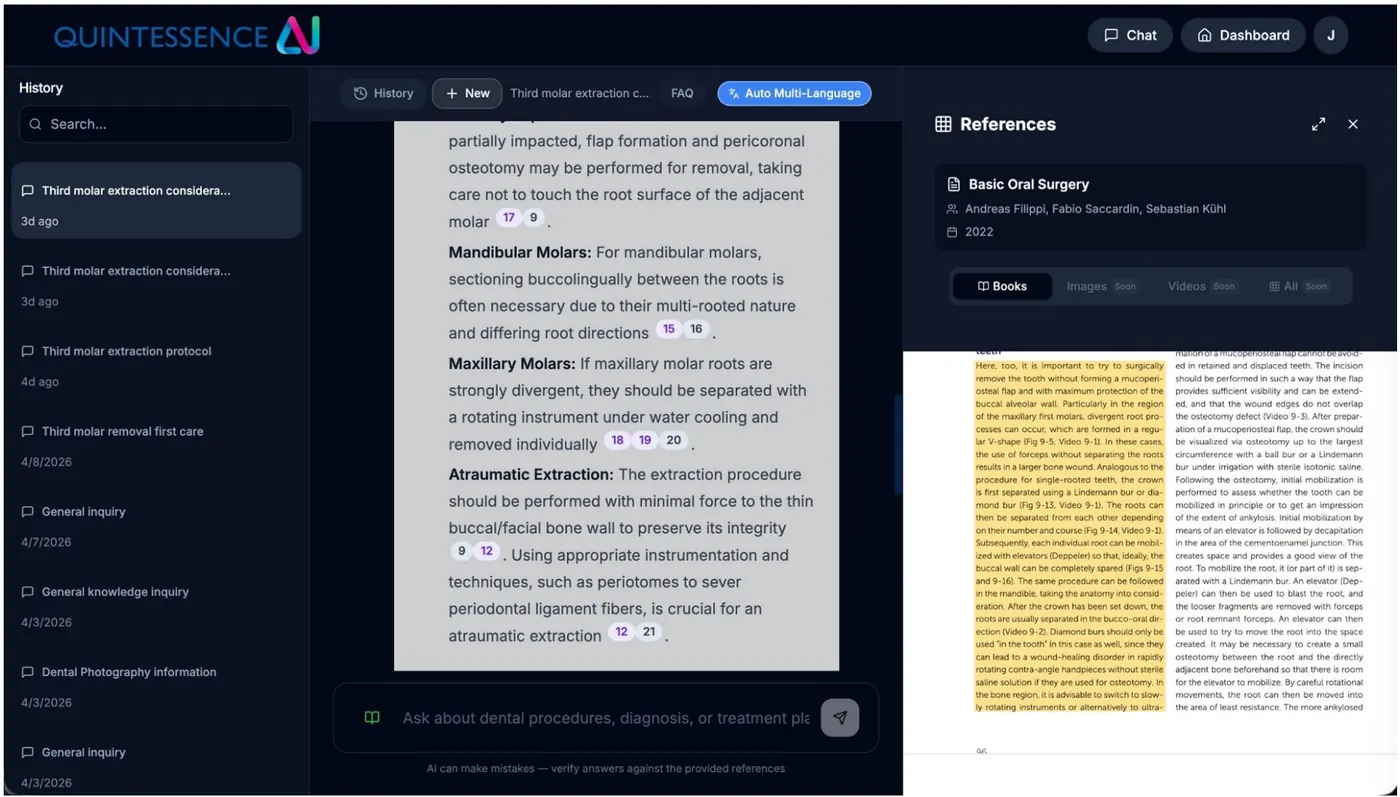
Step 2
Grounded in approved sources
Behind the interface, Uthereal's expert AI platform handles the full pipeline (content ingestion, knowledge extraction, retrieval, grounding, response generation, and analytics) so every answer is traceable to approved Quintessence content and PubMed-supported evidence.
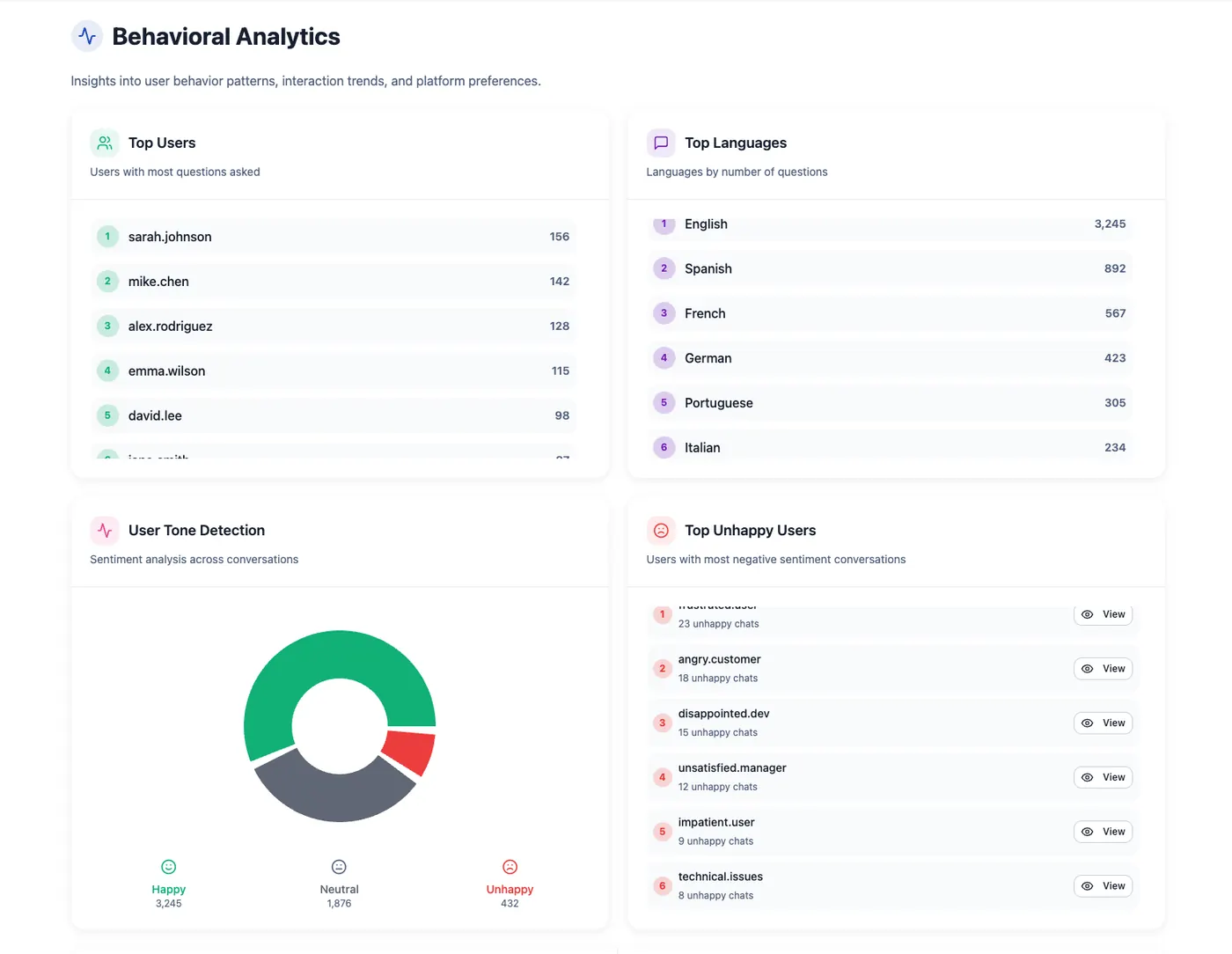
Step 3
An interactive knowledge product that improves over time
Quintessence moved from static content access to a continuously improving knowledge product: multilingual, searchable, and contextual to a clinician's workflow, without giving up editorial control.
The outcomes
Measurable shifts after deployment, across efficiency, productivity, and growth.
Unified
Efficiency
A single AI assistant answers clinical and academic questions across Quintessence content and PubMed-supported evidence: no more hunting across books, journals, and databases.
Faster
Productivity
Practitioners ask clinical or educational questions in natural language and receive evidence-grounded answers in seconds, not minutes.
New
Growth & ROI
Quintessence launched a new AI-native product line built directly on its trusted dental knowledge base, extending revenue beyond traditional publishing formats.
In their words
“Uthereal helped us turn 75 years of editorial authority into a product our community actually uses every day, without compromising on the rigor that makes Quintessence, Quintessence.”
“Evidence-based, transparent, and grounded in our own content. That combination is what made this AI safe enough to put in front of clinicians.”
Frequently asked questions
Turn your archive into an AI product.
If your team owns the trusted content in your domain, Uthereal can help you turn it into a secure, evidence-grounded AI experience your readers will pay for.
